Monday, August 24, 2009

The Gift of Missing Me

Last November, sitting quietly on a stump, smoking a fine smelling cigar, no doubt rolled on the thighs of an octoroon Cuban woman, I heard one of the finest lines ever muttered by a fellow brother of the flyfishing fraternity. In many ways it encapsulated subconscious thoughts I would like to think I am capable of and yet had not expressed. Like so many iconoclastic ideas, it was simplicity itself. Sitting there above a spectacularly clear pool on the Metolis River, a place your imagination is NOT fertile enough to conjure, no insult intended, he was telling me he lived in Bend, Oregon and was an aspiring guide who probably fished fifty or more times a year.

I took note that he was not a youngish man, more into his thirties, who had moments before made reference to his wife.

Always keen to know how other fishermen are able to sell their obsessional neurosis to their spouses without risking apolcalyptic outcomes, I inquired how he was able to get so much time for his unhealthy habit. He said that he had told her this weekend he was fishing and told her he was giving her 'the gift of missing me." After wiping the tears from my eyes, you decide their source, I slowly digested the line, like an anaconda savoring a fine feral pig. One reason I enjoy fishing, truth be told, is that you are more likely than not bound to find a character or two, someone whose alignment with the Earth is a bit off and who, as a result, can show you things you had not previously seen. The mystery of human relationships revealed, for example, in a passing comment. I concede that this may not be a gift that keeps on giving, and must be used with particular caution and judiciousness, but when you absolutely must go, when your irritability level has reached redline, and the thought of a river or coastal scene floods your consciousness, lifting you off the banks, and when charm seems utterly beyond your capacity, try this. But don't blame me if, as a result, she gives you the gift of missing her.

Thursday, July 23, 2009

Hex Hatch- Lost Lake- Mt Hood Wilderness


Hexagenia mayflies are seldom seen, but talked about nonetheless. Large (2") and bright yellow, it is no wonder that they seek out the twilight to rise from their burrows and fly vertically into the evening. They are prime forage for aquatic and airborne predators. I saw rainbows, nighthawks and a large bat species feeding on them simultaneously. Had it been an hour earlier and these mayflies would never have survived the oslaught. They seek out muddy bottoms of alpine lakes and take at least two years to develop; as nymphs they are large- size 4 or 2's. As adult emergers, ridiculous. Check out my photos.

My oldest son & I spent two nights on Lost Lake, Mt. Hood Wilderness, trying to time the evening hatch and finding the window of opportunity quite narrow, to say the least. The hatch took off between 9:00 and 9:20pm both nights, leaving us scratching our heads and wondering whether we had missed something. But no, that was it. How ephemeral, how mayflyish.

The good news is that such alpine lakes harbor decent trout fishing during the other hours, as well as ample opportunity to enjoy the amenities of the lake for swimming and general carousing.

Monday, July 20, 2009

One Fly, Two Fish


Sometimes, quite rarely, the stars align and fate hands you an undeniable gift. That has happened to me from time to time in life, and nowhere more conspicuously does it happen then while fishing. That is probably a result of your senses being attuned through hours of concentration to your surroundings, coupled with the knowledge that things can always end badly- so when they work out, when the hoped for actually materializes, we sit back with pride, knowing all the while that the world gave us a gift over which we had very little control. Sure, feel pride, but deep down realize that nothing needed to turn out this way, and be thankful to the unseen hand.

This is a circular way of saying that I had an experience with one fly you just do not hear about. I am a believer that there is nothing new under the sun. That is borne out by watching cable television at any hour of the day; if you can think it, then it has already happened. Nonetheless, if any of you have heard of this one before, I am all ears. It happened when I fished Long Island, Bahamas, the last two hours of the last of six days of fishing, sun starting its low angled sloping into the horizon line. The trip already having met our expectations, this was just another day of magic. We returned to the ocean flats, anchoring in an azure channel, hoping to land some jacks. As I rigged my twelve weight, I tied on an 80 lb shock tippet and a chartreuse cuda fly to do some deep dredging on the swing. Looking across the channel I was struck by a sudden surface commotion as a school of large fish, moving quickly, porpoised and disappeared. This happened several times; their backs barely breaking the surface, but by their length I thought they were some type of small shark. After several casts, one struck and I was amazed to feel a bonefish on the other end of the line, and not a small bone, but a 7 lber. Colin Cartwright, our guide and the fishing camp owner (Cartwright's Bonefishing Lodge) said he had seen this behavior, albeit rarely and usually by larger class fish, who see to come to the channel to feed on small fish.

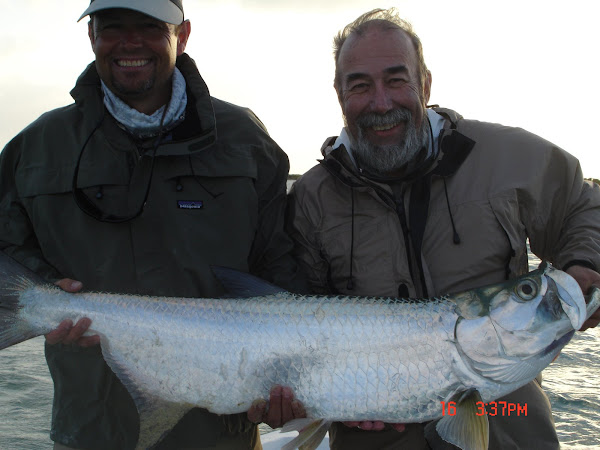
By now the clock was running out and we made one more move before the end of the day, to the large confluence of channels where we had see and heard large tarpon sucking in air on several previous visits. On my third cast, without changing the fly, I let it sink into the blue and began my retrieve. The take was solid and I knew immediately it was a nice fish and was thankful it was on my Twelve weight with my heavy Abel reel and plenty of backing. Looking forty yards off, I watched the line rising as the fish broke for the surface, and there it was! The tarpon you see with Dan's hand in its mouth. Two fish, one fly- but a bonefish AND a tarpon? Anyone heard that one before?

Sunday, June 28, 2009

Oregon Albacore flyfishing

Oregon actually has an offshore tuna fishery available to flyfishermen who don't get seasick. This is the longfin albacore. It sometimes approaches within 20 miles (with el Nino) but more often is past the 30 mile mark. I have a 12 wt and I am stocked up with bonine. They troll flies or chum them in with live bait and there is no catch limit as they are not considered threatened, which is typical American management for maximum sustainable "yield", a topic unto itself, just ask anyone currently suffering through the second great collapse of the striped bass fishery.

I also have some anchovie flies tied by Rick Vandenburg which I won as a door prize at his slide show on a cold Maine CCa gathering highlighting his offshore big boat trip out of San Diego a couple years back. I expect to do some tying shortly; nothing provides me a greater sense of accomplishment that tying big saltwater flies, using synthetic materials, like ultrahair, to form a pallet of color, blended together and anchored by a glass-like epoxy head. Trey Combs has the best offshore saltwater fish hooks on the market; I believe you could tow a small vehicle with them because their shanks are such thick posts of steel. With luck I'll have some pictures in the not too distant future to share.

Pardon my lapse of time, I had a two week renewable energy law class to get through plus twenty page take home exam. Ha.

Monday, June 22, 2009

Evil Fish- Part Two

See the Video below for Part One of Evil Fish.

I can tell you that this six day trip yielded forty pages of notes about bonefishing; when I tell people about this trip I say, "It was like every morning was Christmas." Of course, I have been accused of getting up at 1am for a four am trip, just to organize my flies and re-tie my leaders. I will tell you more about this trip sometime in the future. Right now, it being June 22d, the day after the Summer Solstice, you have no excuse but to be out somewhere on the water. I can't think of any place in the Northern Hemisphere where you can't find fish activity right now.

Evil Fish

Except for Pike, I suppose few fish I am apt to run into in the Northwest can be described as evil- which is actually a compliment in my book. I love nothing more than to throw a surface popper at a pod of bluefish and watch them race each other to blast it free. They also have a black pupil in a yellow sclera that follows your hand around, even when out of water, a good reason to invest in a boga grip and be patient when landing. I have never seen what a set of bluefish jaws could do to the human hand and I would prefer to not have to witness that, having seen that they can easily cut a mackeral in half. I recommend John Hershey's book "Blues" to provide a complete description of them for all their ferocity and beauty. They are marauders to anything smaller than themselves; the fact that they are candy to Mako sharks and bluefin tuna raises them even higher in my regard.

All that being said, I did discover the most vicious fish I have yet known while on my first Bahamanian bonefish trip a year ago. Capable of the kind of speed that you really just have to witness to believe, the barracuda sets a high standard. When wading across a flat, from a mile away in the morning calm, you can hear them rip through a school of bonefish, and if you're lucky see the roostertail of their dorsal fin. From such a distance the scattering sound of a large school of bones is like a large handul of pebbles thrown high into the air. I read somewhere that predator/prey evolution caused the north american antelope (a.k.a. pronghorn) to acquire its 55 mph speed. Its predator, now long extinct, was a cat-like speedster, much like a cheetah. Each stride of the antelope now is testimony to a shadowy fear no longer in existence. I would find myself squinting as I watched an antelope put on its afterburners, as I crossed Wyoming, to see if there was an apparition silouetted in the dust cloud, closing the distance. Without the cuda, there would be no bonefish, and we anglers would be all the poorer for it.

This video is taken of a good friend of mine, Vic, who at first unknowingly works a bone close for release, only to be surprised in a big way. I continued filming and the second segment follows. Be aware that even the guide was disturbed by this large cuda, which I estimate at over five feet and forty pounds. We treated the fish gingerly as we walked backwards, trying to get some distance from it. It wouldn't leave us alone until it got the head; that struck me as a matter of pride. Despite their best efforts, I doubt cuda get too many bones. Enjoy.

Saturday, June 20, 2009

Portland, Maine to Portland, Or


My family is bi-coastal. I have lived in Maine for over 15 years of my life and now Oregon for over seven years. They share similar features in the love their natural gifts inspire in others and their offbeat sense of who they are. They inspire geographic egocentricity. I have hiked, camped and boated extensively in both states and they are both counterfoils. Maine is deciduous woods, ancient mountains, stunning islands and coastal fog. Oregon has volcanic peaks, sun blasted high chaparral, sage brush, and rivers that flow as blue as Paul Newman's eyes. It's ocean is less forgiving, a wild animal, whose intent is always to be questioned. I have come to love them both but sadly I can only live in one place at a time. At this point in my life I do not foresee returning to live in Maine, in no small part because of children and work. The common thread that runs through all this is my love of flyfishing and need to get out on a regular basis to immerse myself in the surroundings and feel the pull.

As I sit here at my desk in Oregon, I am buffeted by memories of cruising Casco Bay or the Elizabeth Islands, expectancy thrumming through the rigged lines, feeling the hull rise and fall atop the gentle swells and watching for birds or a place where the clues give rise to fish beneath. fishing acts a s a bridge between human and nature, leaving one constantly alive in the present yet always searching for new means of connecting. The Elizabeth Islands, for one, a archipelago stretching from Woods Hole, Massachusetts south, and owned almost entirely by the Forbes family, remains largely undeveloped. You find quintessential striped bass habitat along its shores, huge glacial rocks jutting twenty feet from the bottom, tidal rips caused by water forced through narrow funnels of land, coves that trap bait, and Vineyard Sound's constant flushing action. I have seen the waves jumbled like granite chunks against each other, pyramiding ten feet, and glass-clear calm, where a mosquito's spit could be seen on the surface a mile away.